What is a Discrete Probability Distribution?
A quick introduction to the mathematics behind Monopoly.
PROBABILITYMA
1 min read
Probability Distributions in Board Games
Many board games, such as Monopoly and Backgammon, require players to roll two six-sided dice and sum the results to determine their score for that round. Since each die has six faces, the total number of possible outcomes when rolling two dice is 36.

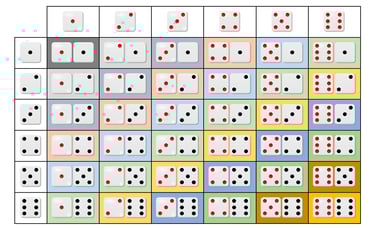
However, the probability of achieving different scores is not evenly distributed as some sums occur more frequently than others...

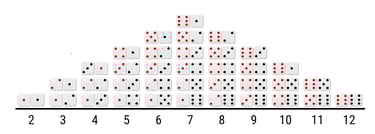
a score 7 is the most likely outcome
a score of 2 or 12 are the least likely outcomes
So What is a Probability Distribution?
A probability distribution is a way to represent the possible outcomes of a random event along with the probability of each outcome occurring.
In this case, our random variable (X) represents the sum of the two dice. The notation P(X = x) refers to the probability that X takes on a specific value x. Since X can only be one of the whole numbers from 2 to 12, it is classified as a discrete random variable.
The probability distribution of X can be represented in a table, showing each outcome and the likelihood of rolling it.


Properties of a Probability Distribution?
The random variable X can takes on specific values like 2 and 3 and nothing in between.
The sum of all the probabilities is 1